One Open Bottle, Half a High Street: The Case for the Late Saturday Pour
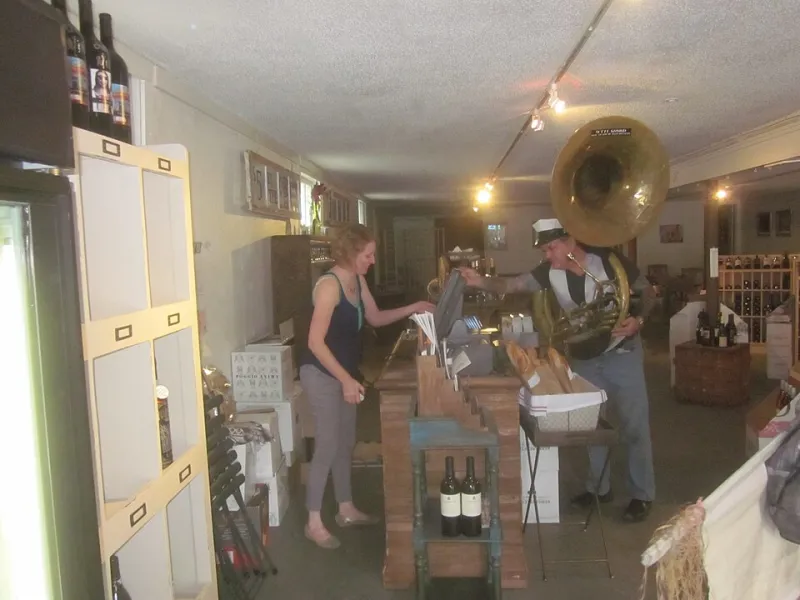
Photo: Infrogmation of New Orleans, CC BY-SA 2.5, via Wikimedia Commons
There is a particular kind of tired that arrives on a late-November Saturday in a UK high street. The bags are heavy. The lights are already up. Someone is playing Mariah Carey at a volume that suggests a personal grievance. You have bought a candle you do not need and a present for a cousin whose name you had to check. And then, if you are lucky, you pass a wine shop with a bottle open on the counter and a hand-written sign that says: try this, it is lovely.
That is the whole idea. One open bottle. No ticket. No masterclass. No PowerPoint. Just a glass poured by someone who knows the wine and is happy to talk about it if you want to, or leave you alone if you do not.
The late Saturday pour is not a new invention. Plenty of independent shops have done it for years, often with a corkscrew behind the till and a stack of plastic cups that would not pass a somm exam. But it deserves to be treated as a proper part of the trade, especially in the run-up to Christmas. It is not a gimmick. It is retail with a pulse.
Why 5pm on a Saturday works
Saturday afternoon is when the high street is at its most mixed. You get people who came out for a specific bottle, people who are killing time before a dinner reservation, people who have never been in the shop before and are slightly afraid of the shelves. A formal tasting can be intimidating for all three. A low-pressure pour is not.
The timing matters. By 5pm, the serious shopping is mostly done. The mood has softened. People are more willing to stand still for five minutes. In December, when the pavements are crowded and every café is full, a small glass in a warm shop feels like a small holiday. It is not about getting someone drunk. It is about giving them a moment.
And yes, it sells wine. Not because you have tricked anyone, but because a glass is a better argument than a shelf talker. You can describe a wine as having 'bright acidity and a chalky finish' until the cows come home. One sip does the job in half the time. The bottle on the counter is the shop's best shop window.
The low-pressure pour, done properly
There is a right way and a wrong way to run this. The wrong way is to make it feel like a test. No one wants to approach a counter and be handed a glass by someone who immediately asks what they think of the reduction. The right way is to keep it small, keep it warm and keep it optional.
A few practical rules. Pour a modest measure, not a pub double. Have water out. Use proper glasses if you can, but do not be precious about it. Choose one bottle, maybe two, and put them on the counter rather than hiding them behind it. Write the price and a short note on a card. And train whoever is pouring to read the room: some people want the story of the vineyard, some want to know if it goes with roast chicken, and some want to be left to sip in peace.
It also helps to pick a wine that shows well after a few hours open. A fragile natural red that falls apart by 4.30pm is not the one. A crisp white, a generous red, a bit of fizz, a fortified wine in small measures: these are the sociable bottles. The point is not to show off the cellar. The point is to show that wine is for drinking, not just for looking at.
Tasting etiquette for browsers
If you are the person on the other side of the counter, the etiquette is simple. Say yes if you fancy it. Say no if you do not. You are not obliged to buy, though buying is a nice way to say thank you if you have enjoyed the glass. Do not treat it as a free bar. Do not ask for a second pour and then leave. Do not announce loudly that you 'know this producer'. And if you like it, say so. That is the whole transaction.
A good shop will not mind if you taste and walk away. The pour is a conversation, not a contract. But there is a lovely thing that happens when you taste something and then buy a bottle for the weekend: you are not just buying wine. You are buying the memory of the five minutes you stood there and enjoyed it.
The December argument
In December 2026, the high street needs reasons for people to slow down. The big shops have their music and their gift sets. The cafés have their queues. A wine shop has something better: a bottle, a corkscrew and a person who can tell you why this one is worth taking home. The late Saturday pour is cheap to run, easy to copy and almost impossible to fake. It says: come in, you are welcome, have a look around.
So here is the case. Open the bottle at five. Put out a small sign. Pour a short glass. Let the high street do what it does, and give it somewhere to land. One open bottle will not save the world. But it might save a Saturday.