The Appetiser Pour: Why Your First Glass Should Do Less Work
Photo: The original uploader was Snow storm in Eastern Asia at English Wikipedia., CC BY 3.0, via Wikimedia Commons
The 7.10 Problem
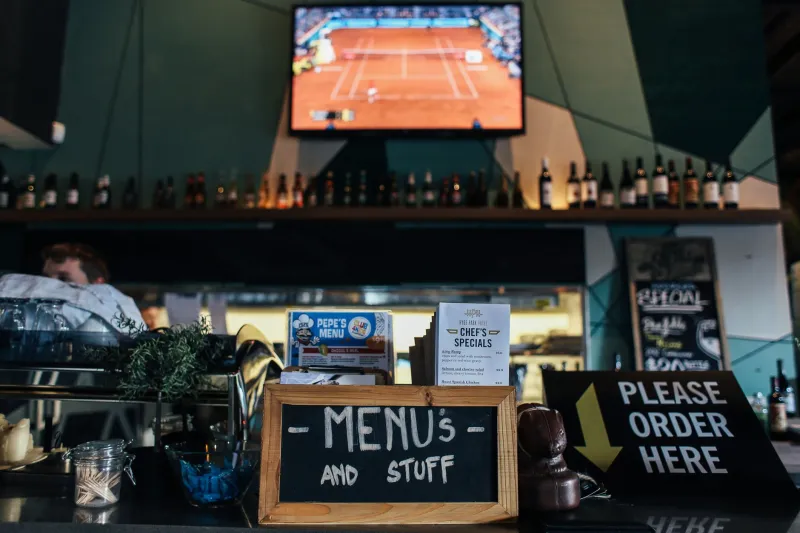
It's 7.10 on a Friday and the chalkboard is doing that thing it does: daring you to start at the top. There's a Barolo by the glass, a grower Champagne, a Châteauneuf that someone has clearly priced to be admired. You've had a week. The temptation is to point at the most serious thing on the list and get the evening started with a statement.
I'd like to suggest the opposite. Order the modest one. The Picpoul, the house white, the Beaujolais that's been on the list since spring. Order it deliberately, not apologetically. Then order the good bottle.
This isn't a plea for austerity, and it's certainly not a rule. It's a small piece of bar craft that makes a night out feel more considered — and, slightly counterintuitively, makes the wine you actually came for taste better.
Your palate has just got off the train
The first glass of any evening lands on a palate that's already had a day. Coffee at 8am, a sandwich at your desk, a bag of salt and vinegar on the 18.42, the third cup of tea you didn't really want. By the time you sit down, your mouth is not a blank page. It's a busy, slightly tired instrument.
A delicate, complex wine poured into that situation is wasted. You'll taste it, you'll nod, and you'll miss most of what's going on. All that nuance — the forest floor, the little whisper of rose — has to compete with commuter coffee and crisps. It's not a fair fight.
A simple, fresh, high-acid white or a light, juicy red does a different job. It wakes the palate up. It's the wine equivalent of clearing your throat before a speech. By the time the second glass is in front of you, your mouth has caught up with the evening, and the serious bottle gets the audience it deserves.
The second glass is the real first glass
There's a well-known phenomenon in tasting rooms: the first wine always suffers. It's partly chemical, partly psychological, and entirely predictable. The second wine gets a palate that's warmed up, paying attention, and calibrated.
In a bar, you can use this to your advantage. If the bottle you've been saving for is glass number two, it walks on stage to a room that's ready. If it's glass number one, it's the warm-up act whether you meant it to be or not — and you've paid a lot of money for a warm-up act.
I've watched people order a £14 glass of something grand as their opener and then spend the rest of the night trying to recapture the feeling. It rarely works. The wine wasn't worse; it was just early.
Ordering for a table without a committee meeting
Anyone who's tried to order for four knows the problem. The moment you ask what everyone fancies, the evening becomes a negotiation. Someone wants something 'not too dry', someone else wants 'a red but not a heavy red', and the friend who did a WSET course once is now explaining the difference between appellation and grape variety while the waiter waits.
A warm-up pour solves this quietly. You order a carafe or a bottle of something easy, affordable and broadly likeable — a Muscadet, a Côtes-du-Rhône, a decent house white — and you buy yourself twenty minutes. Everyone gets a glass. The conversation settles. Then, when the list comes back round, people are relaxed enough to say what they actually want.
It also takes the pressure off the 'big' bottle. If the table is sharing a serious red later, the first glass doesn't have to carry the whole occasion. It's just a nice drink. That's a lower-stakes decision, and lower-stakes decisions are usually better ones.
What actually counts as a warm-up
Almost anything fresh, uncomplicated and not too expensive. A dry white with a bit of zip — Picpoul de Pinet, Muscadet, a young Grüner, Txakoli if you're feeling Spanish. A light red — Beaujolais-Villages, a young Pinot, a chilled Frappato. A dry sherry, if you're in a bar that knows what it's doing, is one of the great palate-openers: salty, brisk, and it makes you hungry in the best way.
What it shouldn't be is a smaller version of the thing you're about to order. If the main event is a Burgundy, don't warm up with a cheaper Burgundy — you'll spend the second glass comparing, and the first will lose. Pick a different grape, a different region, a different mood.
And don't let anyone tell you the house pour is a compromise. In a good bar, it's chosen to be exactly this: the glass that gets the night going.
The economics of starting high
There's a money argument too, though it's gentler than it sounds. A £6 glass of something simple and a £13 glass of something special is often a better £19 than two £9.50 glasses of something in-between. You get range instead of a plateau. You get a story — the cheap one and the good one — instead of a pleasant blur.
It's also a way to drink better without drinking more. The warm-up is not a race; it's a runway.
A small ritual worth keeping
None of this needs to become a rule, and there's no committee that will fine you for opening with the Barolo. But there's something quietly civilised about the warm-up pour: the deliberate choice of a modest glass, the wait for the good one, the sense that the evening is being built rather than simply spent.
Order the simple thing first. Give your palate ten minutes. Then order the bottle you came for, and let it have the night it deserves.